


How to Use AI for Your Tech Job Search in 2026
In 2026, the technology job market isn’t just incorporating AI, it’s being fundamentally rebuilt by it. At DeWinter, our Technology Talent Solutions division sees firsthand how the most successful candidates are those who view AI as a powerful co-pilot rather than a replacement for their own professional narrative. As we navigate the modern technology life cycle—from data engineering to executive leadership—the "proven performer" is the one who knows exactly where the machine’s help ends and human expertise begins.
The search for roles in software development, cloud architecture, and cybersecurity has evolved. We have moved past the era of simple keyword stuffing into the age of
Agentic Hiring, where AI agents are constantly interacting on both the candidate and recruiter sides. In fact,
82% of companies are using AI to scan resumes, according to research from
ResumeBuilder.
To stand out, you must use these tools to deepen your insight, not just automate your output.
Finding the Tech Job That Fits You Best: AI-Powered Job Search Tools
AI-assisted job search features on platforms like LinkedIn and specialized tech boards have become indispensable. In 2026, these tools use "semantic matching" to find roles that align not just with your past titles, but with your actual skill depth and cultural preferences. These systems can predict which environments you are likely to thrive in based on your historical project contributions. However, the key is to use these features as a compass, not an autopilot. While the AI can surface the perfect role, the human touch of a specialized partner like DeWinter is what ensures your application doesn't get lost in the digital noise.
Strategic Intelligence: Beyond the Job Description
The most significant advantage AI offers in 2026 is its ability to perform high-level industry research and intelligence gathering. Instead of browsing a company’s "About Us" page, savvy candidates use AI to synthesize technical debt trends, engineering culture shifts, and competitive positioning. You can prompt an AI to analyze public GitHub repositories, engineering blogs, and recent earnings calls of your target company to identify latent needs or the specific technical hurdles they haven't solved yet but are trending toward.
By understanding a company's competitors and their tech-stack evolutions, you position yourself as a strategic consultant rather than just another applicant. When you come to an interview, mentioning a specific scalability challenge you identified through this data synthesis can help you stand out as a proactive and analytical thinker.
Polishing Your Professional Narrative
Your resume remains your most vital document, but in 2026, it must be both "machine-readable" and engaging for human hiring managers. Proofing and checking your resume with AI is no longer just about grammar; it’s about ensuring your impact data is clear.
Use AI to audit your bullet points to make sure your achievements are clearly stated, quantified, and impactful. For instance, rather than stating you "managed a cloud migration," use AI to help you articulate how you "optimized multi-region latency by 30% while reducing egress costs by $1.2M." This ensures that when an AI-powered Applicant Tracking System (ATS) scans your profile, it recognizes the complexity and seniority of your work.
Mastering the Mock Interview: AI as Your Virtual CTO
In the 2026 hiring landscape, technical proficiency is only half the battle; the ability to articulate complex logic under pressure is what secures the offer. You can now leverage AI to transform your preparation by having it mimic the expertise of a CTO or specialized technology leader. Instead of practicing generic HR questions, prompt your AI tool to adopt a specific persona—such as a "Skeptical Infrastructure Architect" or a "Product-Driven Engineering Director"—and ask it to conduct a grueling mock interview based on the specific job description. This allows you to refine your answers against current industry norms, ensuring your technical vocabulary and strategic outlook align with what high-level stakeholders expect.
To get the most out of these sessions, don't just settle for a list of questions; use the AI to create a dynamic feedback loop:
- Generate High-Level Technical Queries: Ask the AI to pose "edge-case" questions, such as how you would handle a catastrophic state-store failure during a live migration or how you balance developer velocity with rigorous security compliance.
- Request Critical Feedback and Follow-ups: After providing an answer, ask the AI to "poke holes" in your logic. It can provide immediate feedback on whether your solution was too expensive, too complex, or lacked sufficient scalability, and then pose a follow-up question to see how you pivot under scrutiny.
- Align with Industry Benchmarks: Use the tool to check if your proposed architectural patterns or leadership philosophies match 2026’s industry norms. This can help make sure that when you sit down with a hiring manager, your responses are up-to-date and practical for their needs.
The Pitfalls: When AI Becomes Your Greatest Liability
While AI provides incredible speed, misusing it also poses risks to your strength as a candidate. The most common mistake is "Uncanny Valley" content. If your resume or cover letter sounds like a perfectly polished, soulless template, it tells hiring managers you aren't truly invested. We prioritize voice, personality, and genuine passion. An AI-generated cover letter that relies on clichés like "In the ever-evolving landscape of technology" is an immediate signal to a recruiter that you didn't put in the manual effort.
The data backs this up, with 80% of hiring managers saying they "dislike seeing AI-generated CVs and cover letters," according to a survey of 625 hiring managers conducted by CV Genius. It's helpful to think of AI as a tool to polish and improve your authentic, personal candidate profile, not to create it from scratch.
There’ss also the Truth Gap, often caused by AI "hallucinations." AI tools frequently try to "help" by exaggerating your skills to match a job description. If an AI adds "Kubernetes security" to your profile because it's a high-value keyword, but you cannot explain the difference between a NetworkPolicy and a PodSecurityPolicy during a technical deep-dive, your credibility is destroyed instantly. Honesty regarding your technical ceiling is more valuable than a broad but shallow list of keywords.
Finally, avoid the
Efficiency Trap. Mass-applying to hundreds of jobs via AI "Auto-Apply" bots is the fastest way to get flagged by high-intent filters. Companies have moved toward quality over quantity. One tailored, thoughtful application facilitated by a partner like DeWinter carries more weight than a thousand bot-driven submissions.
When and How NOT to Use AI in Your Job Search
There are moments in the technology life cycle where AI is a hindrance to your candidacy. Understanding these boundaries is what separates a "commodity worker" from a "strategic hire."
| Activity | AI Recommendation | Why? |
|---|---|---|
| Industry & Competitor Research | High Usage | Essential for identifying a company’s "pain points" before the interview. |
| Resume Impact Auditing | Medium Usage | Use it to clarify your results, but ensure the "voice" remains your own. |
| Interview Role-Playing | High Usage | Excellent for identifying potential technical "gotchas" and practicing flow. |
| Live Virtual Interviews | STRICT NO | Detection tools for "AI Copilots" are standard; reliance suggests a lack of intuition. |
| Technical Whiteboarding | STRICT NO | We need to see how you think under pressure, not how you prompt a model. |
The Human-Centric Future of Technology Talent
In an era of automated screening, your most valuable asset is still a human advocate, from your personal and professional network, or an experienced recruiter. AI can help you sharpen your tools, but it cannot build the long-term relationships that open doors to the "hidden" job market or provide the nuanced feedback needed to close a high-stakes offer.
At DeWinter, we don't just fill roles. We understand the entire technology life cycle—from the developers building the next generation of AI to the Business Systems experts ensuring those models drive ROI. We look for the candidates who use AI to be more efficient but rely on their own expertise, ethics, and leadership to drive results. Use AI to prepare, but use your humanity to win the job.
Are you ready to elevate your career in 2026?
Search our open technology jobs to find your next breakthrough role or see what the top technology roles are getting compensated in our
2026 Technology Salary Guide.
Scale your software platform engineering teams in 2026 with DeWinter’s guide. Learn to hire SRE, DevOps, and Platform talent to build robust, scalable systems.
We’re thrilled to announce that DeWinter has been named to Staffing Industry Analysts’ 2026 list of Best Staffing Firms to Work For in the U.S.
Learn how DeWinter accelerated a mission-driven BioTech startup by placing a high-impact Controller. Our placement transitioned accounting in-house and led NetSuite/Oracle ERP implementations for IPO readiness.
Master your 2026 Finance & Accounting job search with our expert guide. Learn how to use AI for interview prep, resume optimization, and market research. Includes the DeWinter 2026 Salary Guide for benchmarked compensation data.

Discover how DeWinter filled a critical Accounting Leader role for a high-growth Cannabis FinTech firm in just 24 hours. See how our controller-level expert managed 5 global entities and complex revenue recognition before converting to a full-time hire.
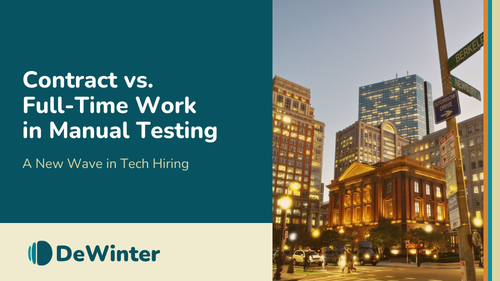
Explore the shift in manual testing careers. Compare contract vs. full-time work and learn how to leverage contracting in tech hiring for long-term QA success.

What will Boston finance & accounting talent earn in 2026? Find updated pay scales and benchmark your salary with our 2026 Salary Guide to stay ahead of the curve.
In 2026, the "safe" and most successful career path is one of continuous upskilling. Whether you are working as a contract specialist or a full-time strategist, your success depends on your ability to treat AI as a teammate rather than a tool.
Discover how AI is reshaping FP&A, Audit, and Tax roles in 2026. Learn the essential AI skills finance talent need to stay competitive in the evolving job market.
Beat Year-End Burnout: The Power of Strategic Finance and Accounting Temporary Staffing